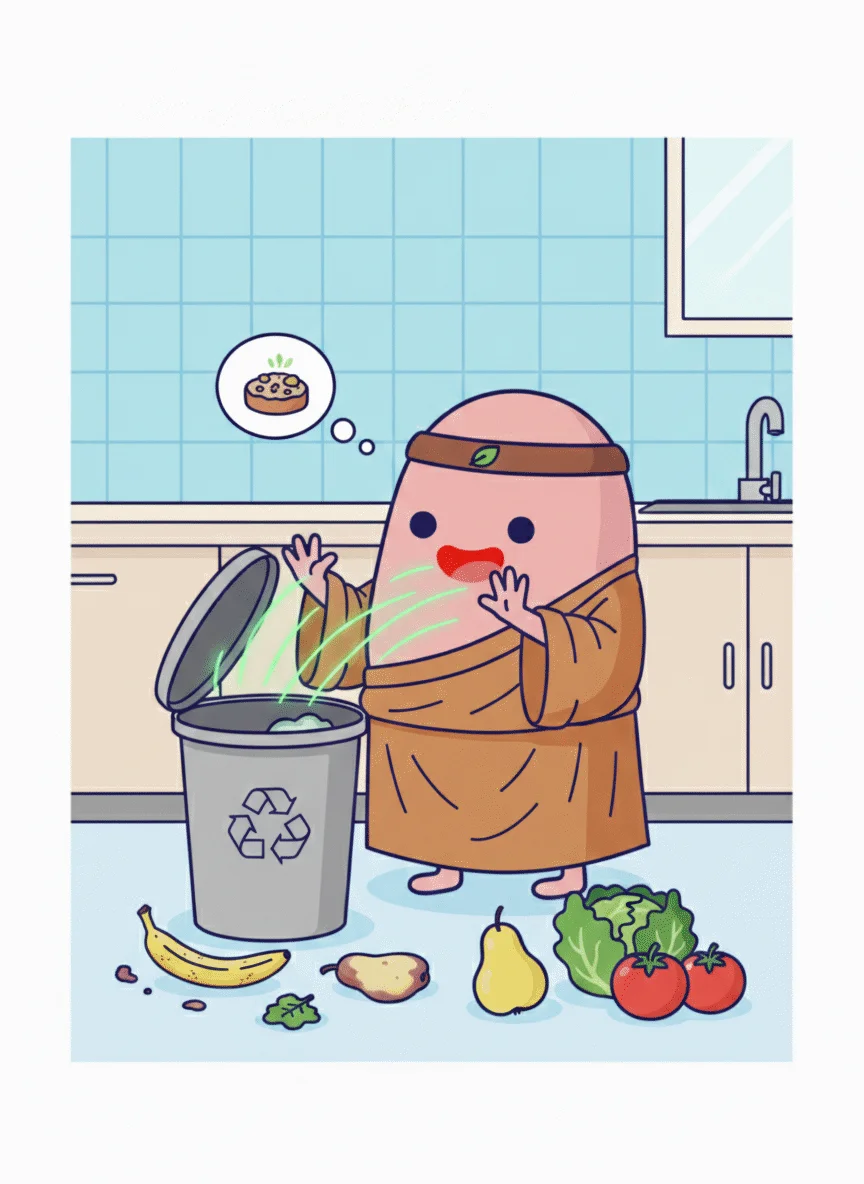
If you've ever tossed out kale you swore you'd use, or discovered yogurt that expired sometime last political administration, welcome. Knowing how to control food waste at home is one of the simplest ways to save money and reduce your environmental impact, and it starts with small changes.
Let's dive into it.
what is food waste and why does controlling it matter?
Food waste isn't just the fuzzy strawberries sitting in your fridge like they're auditioning for a nature documentary. It includes:
- Food you bought but never cooked
- Food you cooked but didn't finish
- Food that spoiled because it wasn't stored correctly
- Food tossed due to confusion about best-before vs. use-by dates
Globally, households waste over 1 billion tonnes of food every year, about 60% of all food waste worldwide.
In the EU alone, households tossed 32 million tonnes in 2022, which is 131-132 kg per person. That's the equivalent of throwing away one in every five grocery bags.
environmental impact
Food waste is responsible for up to 10% of global greenhouse gas emissions, more than aviation. In the EU, waste generates 252 million tonnes of CO₂e annually, making food waste the 5th largest emitter if it were a country.
financial impact
The average EU household loses €500-€1300 per year to food waste when you combine discarded groceries with last-minute takeaway replacements.
Long story short: controlling your food waste = good for your wallet, your stress levels, and the planet.
food waste is a global problem, but controlling it starts at home
global and national efforts to control food waste
Governments are sweating over food waste, and honestly, they should be.
- UN SDG 12.3: Halve global food waste by 2030
- EU policy: Legally binding 30% household food waste reduction by 2030
- Germany: A National Strategy for Food Waste Reduction with household-level interventions
- US EPA: A "Food Loss and Waste Prevention" framework focused heavily on helping consumers waste less
Why all this focus on households?
Because we are the problem… and also the solution.
why households matter more than you think
Households generate over half of food waste in many regions. And the majority of it is avoidable, better planning, smarter storage, fewer impulse buys.
A German study found that small households waste up to 100% more food per capita than larger ones, especially 18-34-year-old urban women… your exact audience.
Even small habit changes scale fast when everyone makes them.
the real reasons we struggle to control food waste at home
Let's normalize this: you aren't wasteful, you're busy.
Here's what actually drives household food waste:
- Overbuying and impulse shopping - You grab three punnets of berries because "smoothie era incoming"... but the era ends 36 hours later.
- Poor meal planning - You buy ingredients for complicated meals… but come home tired and end up making toast and watching Netflix.
- Date label confusion - You toss yogurt the moment it hits its best-before date even though it still tastes like… yogurt.
- Cooking too much - You make a pot of pasta "just in case" and end up with leftovers that could feed a small festival.
- Forgetting what's already in the fridge - You do a "fridge clean-out" and discover you somehow own three open bags of spinach in progressive states of sadness. This one alone contributes to up to 76% of waste in some households.
You're not failing. The system is failing you. And the good news is: you can hack the system.
11 simple ways to control food waste at home (that actually work)
before you shop
1. eat before grocery shopping
Hungry brains make feral decisions.
2. plan meals ahead
Meal planning is the single most effective tool to reduce waste, yet only 37% of Europeans do it consistently, even though 61% say it helps. Not sure whether to plan or prep? Our guide on tips to prevent food waste breaks down which approach works better.
If you want a starting point, try these ideas for meal planning.
3. don't buy something just because it's on sale
A €1 deal is still wasted money if it goes bad.
But if the bargain is just too tempting, scan it into the OH, a potato! app as soon as you get home, grab a couple recipe ideas, and drop them into your meal plan so those ingredients actually make it to your plate, not the bin.
4. use an automated grocery list
An app-generated list like OH, a potato!'s ensures you only buy what matches your actual plan, not your "future fantasy chef" self.
at home
5. store food properly
Up to 76% of household waste is caused by improper storage.
If you want a deep dive, here are great food storage ideas for your pantry.
This is also where OH, a potato!'s preservation tips shine. When you scan ingredients, the app suggests how to store them (like keeping herbs in water or mushrooms in paper), so they stay fresh longer.
6. use older food first (FIFO)
Push older items to the front of the fridge. Your future self will thank your past self.
Pro tip: OH, a potato!'s expiry date notifications do this for you automatically, like a tiny sous-chef whispering, "Hey... your broccoli is entering its 'use me or lose me' era."
7. cook in smaller portions
Cooking huge batches sounds efficient until half of it sits forgotten in the fridge. Try scaling recipes down or planning specific leftover meals in advance.
8. use smaller plates
It's a psychology trick, portion sizes shrink, waste shrinks.
after cooking
9. use leftovers to make new meals
Leftovers are not punishment; they're a head start.
And if you're staring at a container thinking "Now what?", just open OH, a potato! and search for leftover-friendly recipes. The app will show you dishes that use exactly what you already cooked, so nothing gets forgotten in the fridge.
Try remixing leftovers into:
- Grain bowls
- Frittatas
- Quesadillas
- Pasta bakes
10. freeze fruits before they go bad
Bananas, berries, bread, herbs—all freezer superstars. Don't wait until they're past their prime; freeze them while they're still good.
at the store
11. buy imperfect/ugly produce
"Ugly" produce is perfectly edible, often cheaper, and helps reduce waste upstream at the farm.
It's sustainability with a discount sticker.
what to do when food still can't be used
Even with the best habits, some scraps are inevitable.
1. donate safe, edible food
Many local shelters and community fridges accept unopened, shelf-stable items.
2. compost your unavoidable scraps
Composting is great, but remember: preventing waste is still 10x more impactful environmentally than composting it. (When food rots in landfills, it releases methane, a greenhouse gas far more potent than CO₂.) Want to learn more? Check out our guide on how to start food waste recycling.
controlling food waste saves you more than you think
you save real money
EU households waste €200-€300/year in edible food and another €300-€1000 on last-minute restaurant meals caused by wasted groceries.
Even reducing your waste by 20% pays for multiple months of groceries.
you reduce stress
No more mystery mushes in the vegetable drawer.
No more "We have nothing to eat!" panic moments.
you make a meaningful environmental impact
Every kilo of food you save = CO₂, water, land, packaging, and energy saved.
And if you're using OH, a potato!, you see it happen in real time through the impact dashboard, which tracks:
- Euros saved
- CO₂ avoided
Motivation becomes visible, which makes behavior stick.
final thoughts: small habits = big impact
Here's the secret to controlling food waste at home:
You don't need to be perfect.
You just need to know what you have, use what you buy, and make a few smarter decisions each week.
And the best part? OH, a potato! actually learns from you. The more you use it, scanning your fridge, planning your meals, importing recipes, the smarter it gets at understanding how you shop, cook, and forget things. Every week it adapts, nudging you toward choices that save more money and cut even more waste.
Real life is messy.
Your groceries don't have to be.
glossary
- Best-before date: A quality indicator; food may still be safe after.
- Use-by date: A safety indicator; follow strictly.
- FIFO: First In, First Out; use older items before newer ones.
- CO₂e: Carbon dioxide equivalent; measures total greenhouse impact.
- Impact dashboard: A feature in OH, a potato! showing your savings and waste reduction.