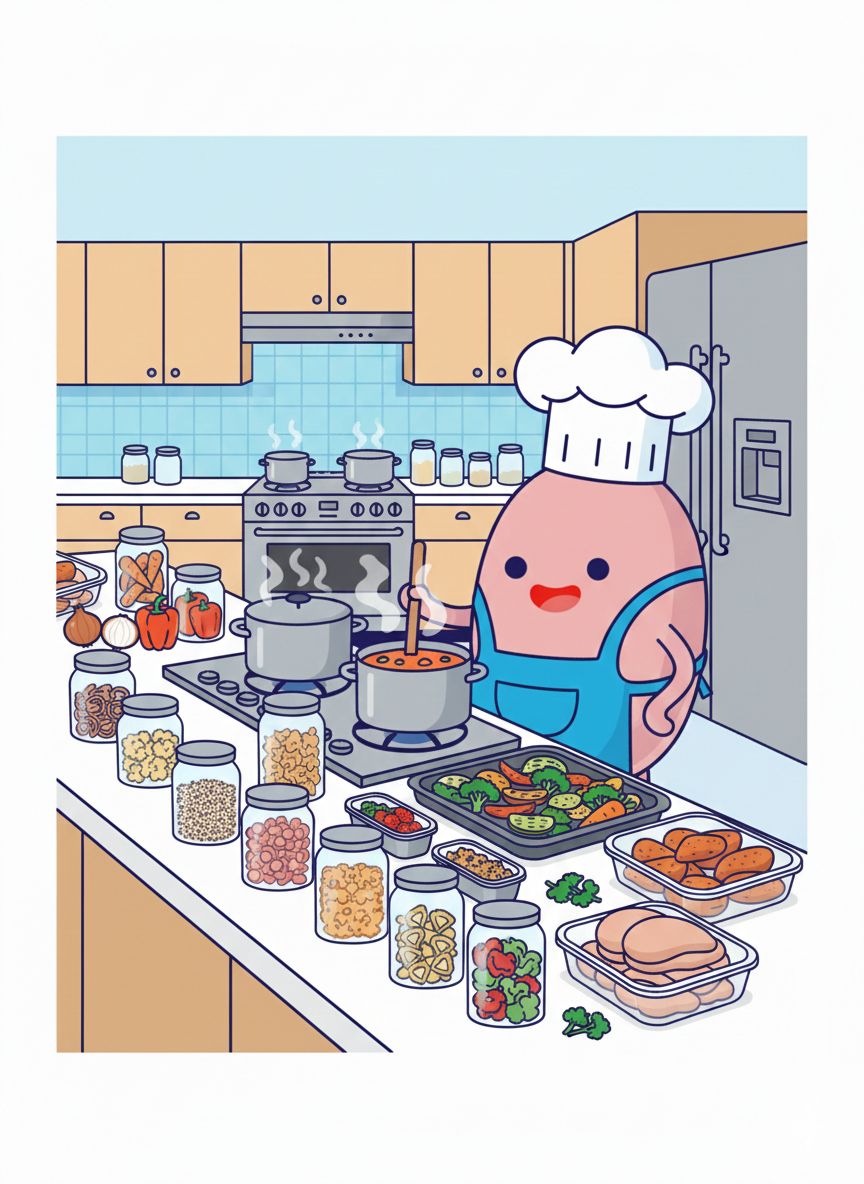
Tips to prevent food waste usually start with "plan your meals"… and then the internet tells you to spend your Sunday portioning 12 identical lunches into containers. So which actually helps more: meal planning or meal prepping?
Let's break it down in a way that fits real, busy, small-household life.
what is meal planning?
Meal planning is the thinking part: deciding in advance what you'll eat and what ingredients you need.
Typical meal planning looks like:
- Checking your fridge and pantry
- Picking a few meals for the week
- Making a shopping list based on those meals
- Optionally, deciding which day you'll cook what
Example for a 1-2 person home:
- Mon: chickpea curry with spinach
- Tue: pasta with roasted tomatoes + feta
- Wed: leftovers + salad
- Thu: tofu stir-fry
- Fri: "anything in the fridge" omelette night
You might still cook day by day. The key is: you've already decided what future-you will be eating, so shopping and cooking are less random.
what is meal prepping?
Meal prepping is the doing part: actually cooking or assembling meals (or components) ahead of time, usually in batches.
Common versions:
- Cooking a big pot of chili and portioning it into 6 containers
- Roasting a tray of vegetables, cooking a pot of grains, prepping a protein
- Preparing overnight oats, salad jars, or snack boxes for several days
You can meal prep:
- Full meals (e.g. four boxed lunches), or
- Components (rice, roasted veg, marinated tofu) that you mix and match
In short:
- Meal planning = the blueprint
- Meal prepping = the build
You can plan without prepping, prep without much planning, or combine both.
how do meal planning and meal prepping compare for food waste?
Here's the side-by-side view.
| Aspect | Meal Planning | Meal Prepping |
|---|---|---|
| Core idea | Decide meals in advance | Cook/assemble food in advance |
| Main moment of effort | Before shopping + at start of week | One or two big cooking sessions per week |
| Biggest win | You only buy what you'll actually cook | You're less likely to abandon groceries for takeaway |
| Main food waste risk | Plans change and ingredients don't get used | You over-prep and don't eat all the prepared meals |
| Best for | Unpredictable schedules, small fridges, picky moods | Fairly predictable routines and freezer space |
| Planning for leftovers | Can schedule "leftover night" and "use-it-up" meals | Built-in portions, easier to freeze extras |
| Emotional feel | "Future me knows what's for dinner" | "Future me has dinner already cooked" |
| Tech/tools that help most | Meal planning app, shared calendar, smart shopping list | Containers, freezer space, labels, portioning skills |
For food waste specifically, meal planning is usually the stronger lever. Meal prepping works best when it's built on top of a good plan, not instead of one.
what does recent food waste coverage say about the problem?
Food waste is having a full-on media moment, and not in a cute way.
globally
The UN Environment Programme's 2024 Food Waste Index found that in 2022 we wasted about 1.05 billion tonnes of food, roughly 19% of the food available to consumers. Households are responsible for around 60% of that waste, throwing out the equivalent of over 1 billion meals every single day.
That waste also drives 8-10% of global greenhouse gas emissions, putting food waste on par with some of the world's biggest emitters.
in the EU
According to a recent European Parliament briefing, food waste costs the EU over €130 billion a year. Households account for more than half of that. The updated EU rules now include binding targets: by 2030, Member States must cut food waste per capita by 30% at retail and consumption level (including households) compared with 2020.
Recent European analyses show that households generate around 130+ kg of food waste per person per year, and that 1-2 person households can waste up to 100% more food per head than larger households, thanks to oversized packaging and recipes that assume a family of four.
in the US
An Associated Press piece in late 2025 highlighted that wasted food in U.S. households costs the average consumer about $728 a year, and generates emissions comparable to 42 coal-fired power plants.
Holidays hit especially hard. ReFED estimated that Americans waste about $550 million worth of food around Thanksgiving alone, equal to 267 million uneaten meals. Overestimating portions and not dealing with leftovers are major reasons.
Another AP story on holiday leftovers stressed exactly what we're talking about here: start with a plan, make space in your freezer, and turn leftovers into new meals rather than letting them quietly spoil.
So when you see "Tips to prevent food waste" in the news, it's not just generic advice. It's being pushed by:
- UNEP (global targets and data)
- The EU (legally binding reduction targets)
- National agencies like the EPA and European ministries
- Climate and consumer organisations calling for smarter household habits
And almost all of them keep circling back to the same behaviours: plan your meals, shop with a list, use what you have, and get strategic with leftovers.
how does meal planning help prevent food waste?
From both research and OH, a potato!'s user data, meal planning is basically the boss level of household waste prevention.
Meal planning is repeatedly identified as the most effective single habit for reducing household food waste. But only ~37% of Europeans do it consistently, even though 61% say they know it helps.
According to Herzberg et al. (2020), who surveyed 6,853 households, smaller households face unique structural challenges that most existing solutions ignore. A 2022 German field study of 730 participants identified five systemic failures that show up again and again in 1-2 person homes:
- Poor storage knowledge (up to 76% of waste): Food spoils before use due to bad storage, long delays, natural decay.
- Planning and prep issues (up to 38%): Limited cooking proficiency, too much cooked, not eaten in time.
- Packaging mismatch (33%): Packaging too large for single people or small households.
- Life disruption (32%): Changed plans, last-minute takeaway, leftovers from social occasions.
- Date confusion (up to 21%): Misunderstanding "best before" versus "use by" dates.
Meal planning hits several of these head-on.
you plan around what you already own
Example: you've got:
- Half a red cabbage
- Three carrots
- A slightly wilted bunch of coriander
Instead of ignoring them, you build a plan:
- Mon: roasted carrots + grains + feta
- Tue: red cabbage slaw with lime
- Wed: coriander in a lentil soup
Suddenly those "nearly gone" ingredients become the starting point, not collateral damage.
you reduce overbuying and duplicate purchases
With a plan + list, you're less likely to come home with yet another tub of hummus when you already had two.
you can engineer overlap
Buying feta? Plan:
- Day 1: feta on roasted veg
- Day 3: feta omelette
- Day 5: feta crumbled into a grain salad
you build in a leftovers lane
You can design your week to include:
- One "leftover night"
- One "use-it-up soup / stir-fry / fried rice" night
you choose realistic recipes for your real week
If your Wednesday is always intense, your plan can call that out: easy pasta or a traybake, not a 2-hour stew.
If you like structure, you can wrap this in a simple dinner planner layout: 3 "proper" dinners, 1 leftover night, 2 emergency easy meals.
how does meal prepping help (and when can it backfire)?
Meal prepping can be a powerful add-on to meal planning, but it's not automatically waste-free.
where meal prepping helps
Portion control: You portion meals when you're calm, not starving. This reduces plate waste.
Better use of bulk ingredients: Buying a whole head of cauliflower or a big pack of chicken makes sense if you cook it all at once and eat/freeze it.
Fewer last-minute takeaways: When there's a decent ready-to-heat meal in your fridge, you're more likely to use the ingredients you already paid for.
Protection for fragile foods: Prepping berries into yogurt jars or roasting veg when you bring them home can extend their life compared to "raw veg abandoned in the drawer."
where meal prepping goes wrong for waste
From both research and holiday coverage, the same issues keep popping up:
Overestimating how much you'll want to eat the same thing: Five days of identical chicken and rice sounds efficient on Sunday and less appealing by Thursday.
Life changing your plans: A surprise dinner invite or late shift can instantly make two prepped meals "extra". Without a freezer plan, they become bin candidates.
Short shelf life of prepped foods: Cooked grains and proteins usually last 3-4 days safely in the fridge. Dressed salads or cut fruit less than that. If you prep too far ahead, you'll have to toss what goes off.
No connection to your actual inventory: If you choose your prep recipes from random inspiration, without checking your fridge first, you might still waste the ingredients you already had.
Bottom line: Meal prepping shines when it's used intentionally on top of a good plan, not as a stand-alone strategy.
which is better for food waste: meal planning or meal prepping?
If you had to choose only one as your main food-waste tool: Meal planning wins.
Why:
- EU-funded research and recent syntheses show that structured meal planning, smart storage and leftovers use are consistently linked to meaningful food waste reductions, often in the 30-50% range in interventions.
- The main reasons small households waste food (overbuying, mismatched packaging, changed plans) are upstream problems. Meal planning tackles these before the food ever hits your fridge.
- Meal prepping, if done without planning, still allows the classic failures: buying too much, ignoring what you already own, and not adapting when your week changes.
So the practical strategy for a small household:
- Start with flexible meal planning as your foundation.
- Layer on light meal prepping where it makes sense:
- Cook double and freeze two portions.
- Pre-chop veg for 2-3 future meals, not the whole week.
- Prep breakfast or lunch for a couple of days at a time.
This approach lines up almost perfectly with the behavioural advice in recent US and EU media coverage: shop with a list, start from your own kitchen, and have a plan for leftovers instead of just "hoping we'll eat them".
how does OH, a potato! make shared meal planning easier?
Now to the fun part: how to make all of this actually stick when you're busy.
OH, a potato! is built specifically to fix the "I know what I should do, I just don't do it consistently" gap. It's designed around small, urban households and their specific pain points.
For this topic, two features really matter: the weekly meal planner and shared household planning.
weekly meal planner (with real-life flexibility)
Instead of forcing a rigid, preloaded set of recipes, OH, a potato! lets you:
- Start from what's already in your kitchen (using the fridge, grocery receipt scanner and smart inventory).
- Build a weekly meal plan that adapts as your week unfolds, recommending the best next steps for ingredients nearing expiry.
- Pull in any recipe you love (yes, including that TikTok you saved three weeks ago) and fit it into a waste-aware plan.
Because it's built to reduce waste, not just calories, it:
- Tries to reuse ingredients across multiple meals
- Prioritises ingredients that need to be used soon
- Connects your meals to a grocery list so you only buy what each plan actually needs
You can then deepen this with our guides on week meal planning and meal planning shopping lists.
shared household planning: one plan, one list, fewer "wait, did you buy milk?"
The shared household planning feature does exactly what the tagline promises: "one plan, one list, one happy household."
You can:
- Share the same weekly meal plan between partners or flatmates
- Share a single shopping list so you don't double-buy or forget things
- See, at a glance, what's planned and who's around on which day
- Gather all your favourite recipes in one place, including imported TikTok/Instagram finds, so everyone plans from the same big pool of "yes, we actually like this" meals
That kills several classic small-household waste scenarios:
- Both people buy salad greens "just in case" → half of them go slimy.
- One decides to cook, the other orders takeaway without knowing → prepped ingredients don't get used.
- Nobody remembers when the chicken was supposed to be cooked → it expires, and you default to delivery.
- Each person has their own random screenshot/notes stash of recipes, so you keep defaulting to the same three dinners instead of using what you already know you enjoy.
By making the plan, list, and recipe pool visible and shared, OH, a potato! spreads the mental load and connects everyone's actions to the same food, the same favourites.
what are some practical tips to prevent food waste this week?
You don't have to overhaul your life. Pick a couple of these and test-drive them for one week.
do a 5-minute fridge and pantry check before shopping
Pull out anything fragile: berries, bagged salad, herbs, half onions, open hummus. Make sure at least one planned meal uses them.
plan 3 main dinners, not 7
For a 1-2 person household, a full seven-day plan can be overkill. Try:
- 3 planned dinners
- 1 leftover night
- 2 "easy option" meals (eggs, pasta, toasties)
- 1 takeout or spontaneous night
use ideas for meal planning that start from your fridge
Instead of browsing random recipes, look at what's in your kitchen and then search for ideas for meal planning that turn imperfect or leftover ingredients into something good.
schedule a leftover night on purpose
Don't just "see if we feel like leftovers". Put it in the plan. Fried rice, frittatas, soups, and wraps are kings of the leftover world. Try our Fridge-Cleaner Friday approach.
store food so it actually survives the week
A lot of waste is just poor storage: herbs drying out, salad going slimy, berries moulding in two days. Our food storage ideas guide can help you set up shelves and containers so more of what you buy stays edible longer.
In OH, a potato!, you get this help right where you need it: when you add ingredients to your fridge in the app, you can tap on each ingredient to see quick preservation tips. Think:
- Carrots → "Remove the tops, store in a closed container with a bit of moisture to keep them crisp."
- Fresh herbs → "Treat like flowers: trim the stems, stand in a jar of water, cover loosely, keep in the fridge."
- Berries → "Don't wash until you're ready to eat, and store in a breathable container lined with paper towel."
- Salad leaves → "Wash, spin dry, and store in a box with a dry cloth or paper towel to absorb excess moisture."
So instead of googling "how long does cooked rice last", you just tap the ingredient in your digital fridge and get the right storage trick to stretch its life a few extra days.
try "mini prep", not full-on Sunday marathons
- Cook extra grains or roast extra veg for 1-2 future meals
- Wash and spin salad greens
- Freeze bread slices, half cans of beans, or chopped herbs so they don't quietly mould in the fridge
match your prep to your calendar
If this week is full of social plans, don't prep four lunches. Prep two, and keep some ingredients flexible so they can be used later or frozen.
use your senses, not just dates
Holiday coverage keeps emphasising this: home-cooked leftovers rarely come with clear "use by" labels, so learn to check smell, look, and texture instead of defaulting to the bin out of fear.
track your "save stats" for motivation
Tools like OH, a potato!'s dashboard or your own notebook can help you see:
- How many meals you made
- How many euros you saved
- How many takeaway orders you replaced with home-cooked food
- How much CO₂ you avoided wasting, and not just as a random number. OH, a potato! translates it into simple comparisons (like "this week you saved as much CO₂ as skipping a short car trip" or "as making X fewer burgers") so your impact feels real and concrete, not just another statistic
Seeing those numbers add up over weeks turns "I should waste less food" into "oh, this is actually working – and it matters."
glossary
- Meal planning: Deciding in advance what you'll eat over a few days or a week, and shopping based on that plan.
- Meal prepping: Cooking or assembling meals or components ahead of time to eat later in the week.
- Household food waste: Food thrown away at home (including inedible parts in many statistics). Households are responsible for about 60% of global food waste.
- 1-2 person household: A home with one or two people. Research shows these households can waste up to 100% more per person than larger households because they're stuck with family-sized packaging and recipes.
- Leftovers strategy: Any deliberate plan for using already-cooked food (e.g. scheduled leftover nights, turning roast veg into soup, or freezing extra portions).
- EU food waste reduction targets: Legally binding EU goals requiring Member States to cut food waste in processing/manufacturing by 10% and in retail + consumption (including households) by 30% per person by 2030.
If you remember nothing else: Meal planning is your main lever for cutting waste. Meal prepping is a tool you layer on, gently, where it supports your real life. And apps like OH, a potato! exist so you don't have to hold the whole plan in your head.